
This week, Arsenal won the Premier League for the first time in 22 years. I have always sympathised for the red clubs in England, perhaps because they were all the rage when I started getting into football.
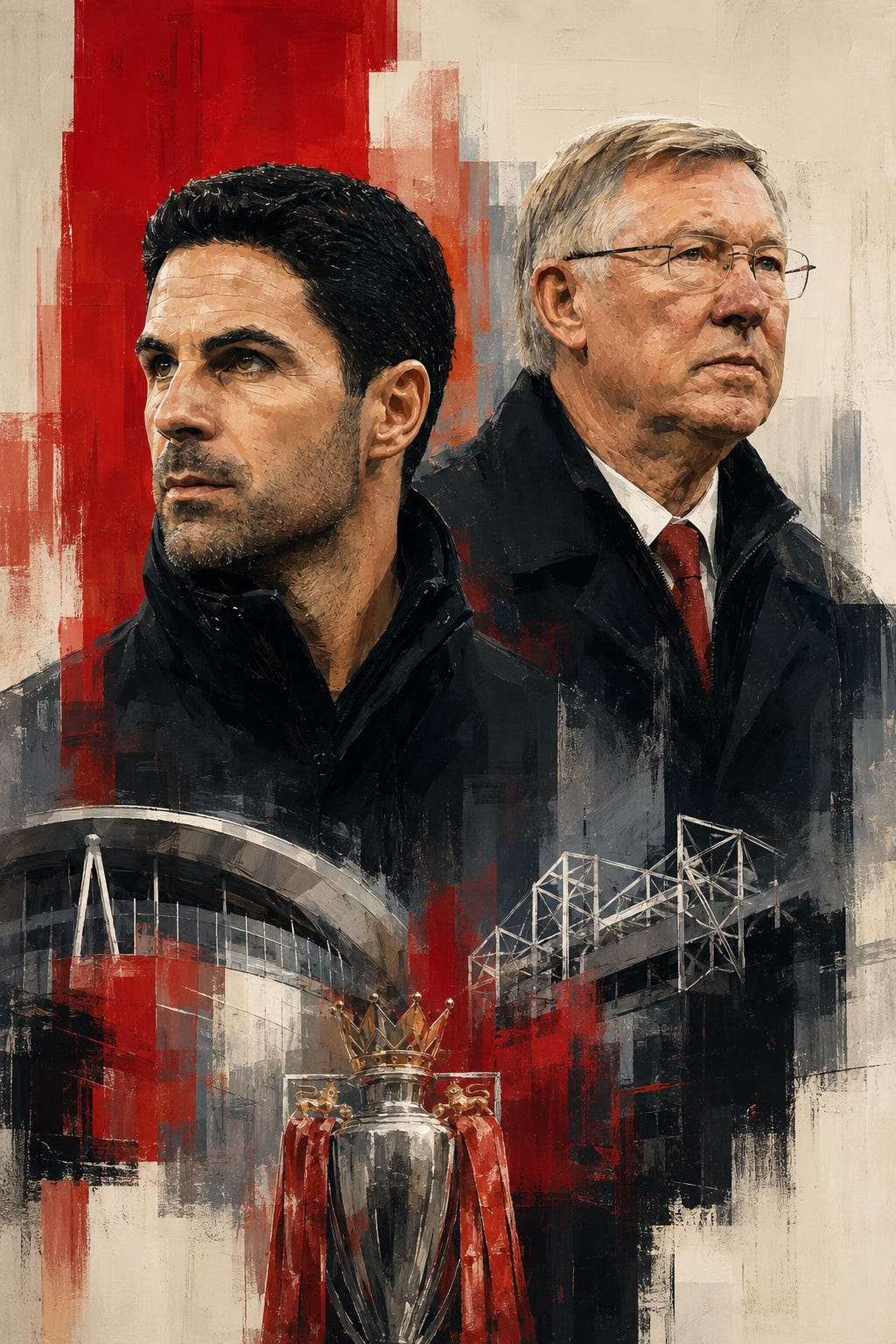
I will never forget the Champions League final between Man United and Bayern Munich, won in the last 3 minutes of the game by United. That team was epic, and it was not built in a day.
One of the best books I have ever read about leadership is Alex Ferguson’s Leading. I don’t think it is an accident that is co-written by Sequoia’s Michael Moritz. That book is all about building for the long term.
It took Sir Alex 6 years to win his first title after arriving to United in 1986. It also took 7 years for Mikel Arteta to win Arsenal the league. United started winning in 1992 and did not stop until 2013, dominating English and European football for almost two decades. It is way too early to say if Arsenal can start a cycle, but I wish them well.
In our day and age short term thinking and constant change are dominating. Yet, building something amazing takes time. It is the compounding effect. You do small incremental gains every day, constant improvements and you cannot help but becoming successful.
To do so, you need to have the right environment. Unfortunately we live in an era that rewards short term thinking, acting fast, and constant change. We are in the social media era, where it is about volume and noise.
There is a beautiful quote from Sun Tzu. If you sit by the river long enough, you will see the body of your enemy float by.
Not that you necessarily need to have an enemy, but it strikes a chord. It is a beautiful reminder that beautiful things take time.
Now back to Arsenal, the parallels with Fergie’s United are striking.
Ferguson arrived in Manchester in the end of 1986 with a club almost at the bottom of the league. His first moves were to remove players that were not functional to his long term vision and confronting the team’s culture. Reading his books, Manchester United in the late 80ies was definitely worlds apart the professional dedication a world class football team required. Players were ill-disciplined and there was more drinking than training hard.
Arteta also arrived in a dark moment for Arsenal. They were not at the bottom of the league, but far away from the top of the table. Emery’s time as a manager had ended and Freddie Ljungberg, Arsenal legend, struggled to turn the tide. The dressing room was in shambles and there were players that despite their talent were mentally checked out. Arteta started by removing such players. Mesut Özil's contract was terminated, Aubameyang was stripped of the captaincy and shown the door, and half a dozen others were moved on. Arsenal finished 8th in back-to-back seasons. The rebuild looked like a disaster from the outside.
For both managers, success did not come after one season or two. Both were on the verge of being fired by year three. Ferguson in January 1990 was saved by a win in the FA Cup against Nottingham Forest. Arteta won the FA Cup in 2020, beating Manchester City 2-0 in the semifinals, and Chelsea 2-1 in the final.
What happened next was also strikingly similar: fix the unglamorous foundations. Before signing star players, both Ferguson and Arteta fixed the defensive spine and this was not done over a transfer window but over the years.
For Arsenal’s fans, the mantra became “trust the process”.
In the spirit of long term thinking and compounding, Arteta’s story at Arsenal is a story of gradual improvements. Every year the team got a little bit better, until it became a title challenger, and after some years of being close to the title but not there yet, they finally won it.
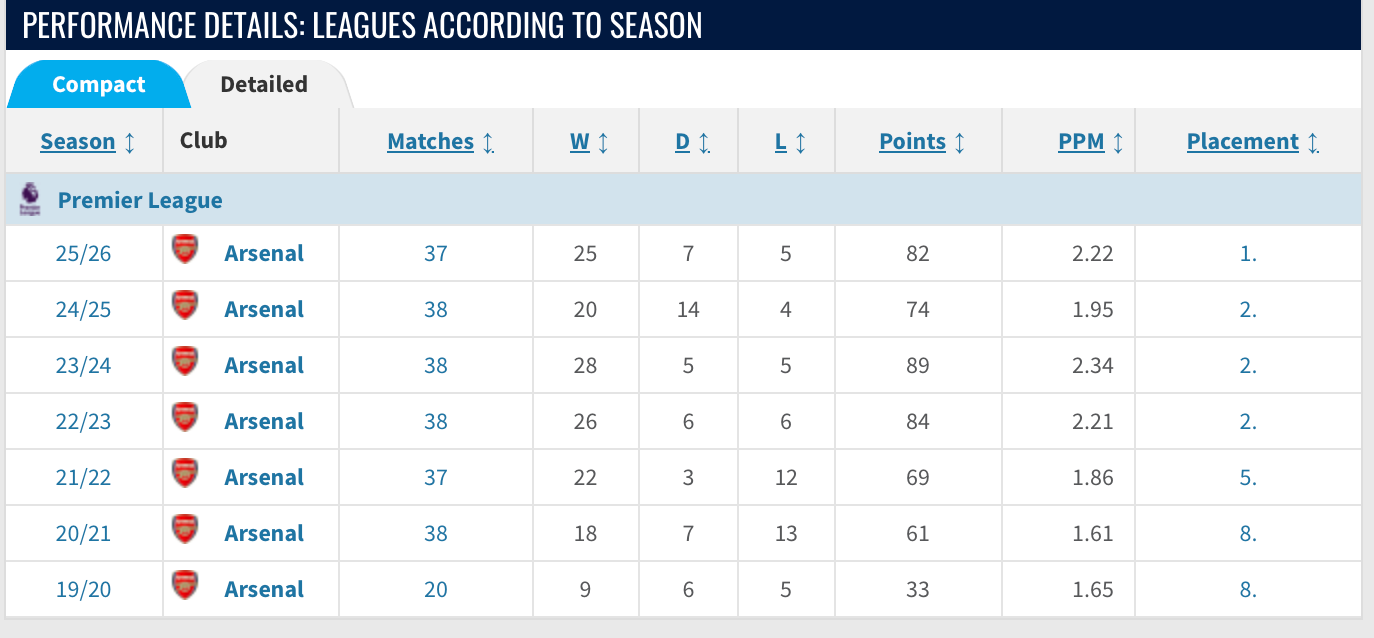
The title did not come after one summer of crazy signing, although Gyokeres came last summer and cost a fortune, but it was the result of many years of right decisions.
It was beautiful to see.
There is another layer of the story that doesn’t catch the headlines. After Wenger’s Invincibles, Arsenal looked like a club dismantling. Wenger was selling the best players every summer - Fabregas, Van Persie, Nasri - and was not replacing them with equally resounding names. But something was happening behind the scenes. Arsenal was building its infrastructure, which took the shape of a brand new stadium.
The Emirates cost almost £400m but doubled the match day capacity and created the revenue base that would eventually fund the success 16 years later.
Ferguson’s infrastructure building did not take the shape of a new stadium, but rather investing in rebuilding the scouting network, doubling down on the youth academy that produced the almighty boys of the 92.
The thing I like about football, aside from the game itself, is the many parallels with leadership and building successful organisations. Football managers are also dealing with insane pressure. They don't have the luxury of having a bad quarter, often it is a string of bad games and they are already grilled by fans and boards. By default, football is about short term thinking which makes it particularly fascinating to see how Ferguson and Arteta built their success over the long term.
William Thorndike’s Outsiders profiles eight CEOs who generated extraordinary long-term returns by doing something similar: ignoring short term noise and compounding quiet, unglamorous decisions over the years. Tom Murphy at Capital Cities, John Malone at TCI, Katharine Graham at the Washington Post, and of course, Warren Buffett. They all accepted to be perceived wrong in the short term but eventually they were proven right in the long run. Just like Ferguson and Arteta.
If I look at my experience in managing teams, I can relate. There is a moment, usually at the beginning, when one takes over a team, where, unless the team is already extremely successful, which is unlikely otherwise why changing manager, where you need to clean up the dressing room and work on the culture. This is something I have seen over and over. Typically, the first thing you do as a new manager is to remove either the low performer or the former superstar that lost their motivation and became a drag.
Next, there is the culture change. Often, in commercial teams it means to go back to basics and remind ourselves that selling ultimately is a lot about doing activities, consistently. Day after day, do that call, see that prospect, ask for the business.
Finding an example of infrastructure building is difficult because it is harder to see in real time. There is one thing that comes to mind.
At the beginning of 2026 we announced a compensation revamp for our commercial teams shifting towards revenue generated.
It was a big change, especially for sales reps.
I won’t lie, it was painful. We got absolutely destroyed in the first Employee NPS of the year. Results also stalled in the first couple of months, and in the moment, it felt like we did something stupid and had broken something that made the company successful in the past 7-8 years.
After the first quarter though, we noticed that the new inventory performed significantly better than what we brought live in Q1 2025. We are in the midst of Q2 and it is honestly too early to declare victory but the early signals are pointing in the right direction.
To some extent, this feels like Fergie’s or Arteta’s FA Cup victory. The culture meant as behaviours, has started to change. Nobody knows now if this will compound into something lasting. You rarely see this at this stage, only time will tell.
The reality is that long term thinking is not something that comes naturally to us humans. We are wired for dopamine. Our brains are constantly seeking the next hit. We need progress today. That’s why a lot of folks lose their shirt trading frequently, yet the best capital allocators are all long term thinkers. Evolution did not optimise humans for twenty two years without winning the Premier League. We are made for survival, which is the short term.
Building something that stands the test of time requires us fighting this instinct continuously. It requires the discipline to make unglamorous, controversial, and perhaps boring decisions.
Decisions that don’t pay off today, or even next quarter, this season or next.
It requires the ability to sit patiently, don’t panic, and resist the pressure to go back when things look bleak. I honestly felt that in mid Q1.
Last but not least, it requires the support from above. Ferguson, Arteta, the CEOs from the Outsiders all had the luxury of having someone that was patient enough to let them compound.
Behind every long term success story there is someone at the top who chose not to panic.
It is not human, if you have it in your organisation, cherish it and treat it as the asset it is.
Thanks for reading,